
How to Search the Missouri Residents Directory
There is no complete public roster of Missourians. The state's 114 counties and independent St. Louis City each maintain their own records. Property rolls, deeds, tax files, court indexes, and election records all stay local to them. So jurisdiction comes first. Match the address to a county, then work from there. A parcel identifies property. A deed names the parties to a transfer. And a court index lists litigants. None of these proves who lives at a house today.
Searching a person works best with a date or record number attached to the name. Older households may live only in archives. Some vital and court records stay restricted, and owner rolls say nothing about occupants. Keep the source, date, and jurisdiction with every residents directory result you save.
- Resolve the county or independent St. Louis City for the address.
- Use the assessor or parcel map to identify its number and owner fields.
- Follow transfers through the Recorder, then check a court or agency source if needed.
- For past households, use a dated directory, newspaper, plat, or Archives collection.
- If online access stops, ask the custodian about terminals, indexes, microfilm, or a focused Sunshine Law request.
The state's Sunshine Law offers another route. A focused request should name the custodian, the record, the dates, and the format you want. The custodian generally must respond by the third business day or explain a delay. Any denial should state its legal basis.
Missouri Residents Directory Records and Offices
State offices keep the statewide series, yet land and tax files stay local. Every county runs its own Recorder of Deeds, assessor, collector, and election authority. St. Louis City has separate city offices. The Archives county guide routes older requests by office and by record type.
The Archives itself preserves indexes and microfilm. DHSS handles vital records, while local custodians keep the originals. The Secretary of State selector identifies each election authority.
Sunshine Law copy fees generally allow ten cents per paper page plus permitted staff, research, or duplication time. Advance payment may be required. An unpaid request can be withdrawn after notice and 90 days, or 150 days when estimated fees exceed $1,000. Ask for an estimate first. Confidentiality rules still apply.
Missouri State Archives
County records, state indexes, and microfilm
Jefferson City and online collections
DHSS Bureau of Vital Records
930 Wildwood Drive
Jefferson City, MO 65109
573-751-6387
Eligibility and copy procedures vary by record type
Local Election Authorities
County and St. Louis City offices
Registration records are maintained locally
Current Missouri Resident Records
A deed names transfer parties. A voter record shows only its statutory fields. A business filing may name a registered agent. These are not interchangeable resident directories, and the table shows which records office can support each fact.
| Record source | What it can show | Keeper | Access path |
|---|---|---|---|
| Assessor or collector record | Parcel owner, tax account, value, and sometimes mailing address | County or city office | Local portal, counter, or request |
| Voter registration | Limited name, year-of-birth, address, and precinct fields | Local election authority | Own-registration lookup; statutory records by request |
| Recorded deed index | Grantor, grantee, filing date, and legal description | Recorder of Deeds | County or city search; older books may be in person or on film |
| Case.net | Public case parties, dates, dockets, and dispositions | Missouri courts | Online case search; clerk or public terminal for records |
| Historical directory | A dated name, address, and printed household notation | Libraries and archives | Digitized collections, shelves, or microfilm |
A property result can open a street directory search. A dated volume can place a household at an earlier address. Coverage varies by county, though, so a blank result may mean the record sits offline or in a different index.
Missouri Business Records Are Not Home Rolls
The Secretary of State's business-entity search covers registered corporations and business names. These include current and dissolved entities. A filing can identify a registered agent, an organizer, or a business address. But none of those roles establishes who lives at the listed location. Use the Missouri business search when an entity name or filing needs checking. Property questions belong with the assessor or Recorder of Deeds.
The Division of Professional Registration offers another bounded name source. Its profession-specific pages can show a licensee's name, city or state, license number, status, and issue or expiration dates. Board detail and historical depth vary, though. The Department of Corrections searches people under active supervision, including probationers and parolees. It excludes discharged people and some confidential records. The Highway Patrol's offender registry carries its own eligibility and status rules. None of these is a list of all Missouri residents. And a matching name alone never connects a license, filing, or registry entry to a home.
Missouri Voter Lookup Has Narrow Fields
The Secretary of State's Missouri Voter Information Lookup checks registration and polling details. It matches on exact first and last name. It also matches birth date, the last four SSN digits, and county. Nicknames fail. So does the wrong county. The tool lets a voter check their own record. It is not a street-address roster.
| Lookup field | Format or use | Limit |
|---|---|---|
| First and last name | Enter the registered spelling | A nickname may fail |
| Date of birth | MM/DD/YYYY | Used to match the registration |
| Last four SSN digits | Four-digit matching field | Not a public display field |
| County | Choose the registration jurisdiction | Missouri keeps local election authorities |
RSMo 115.157 defines the public voter fields, and RSMo 115.158 limits commercial use. Want a full file? Ask the local election authority about a lawful print or electronic copy. Specify jurisdiction, fields, geographic scope, intended use, and format. The office can explain fees and disclosure limits.
A statutory file differs from the self-check form. Public fields include name, year of birth, and residential address. They also cover ward or precinct, districts, and party designation. Birth date and SSN digits serve only as matching fields, never as public display fields. Protected-address rules may restrict disclosure.
Missouri Parcel Searches Show Owners
Missouri has no statewide assessor search joining every county. The State Tax Commission assessor directory helps you locate the right county records office. St. Louis City offers a useful example. Its official address service accepts an address or parcel number, and the page states plainly that it does not search by owner name. That city portal is separate from St. Louis County's tax inquiry system.
The St. Louis City lookup returns an owner, a separate mailing address, parcel and account identifiers, assessed values, tax history, a legal description, permits, and map layers. It describes a parcel, not occupants. The owner may be an entity or get mail elsewhere.
See the St. Louis City address and parcel search for the live lookup.
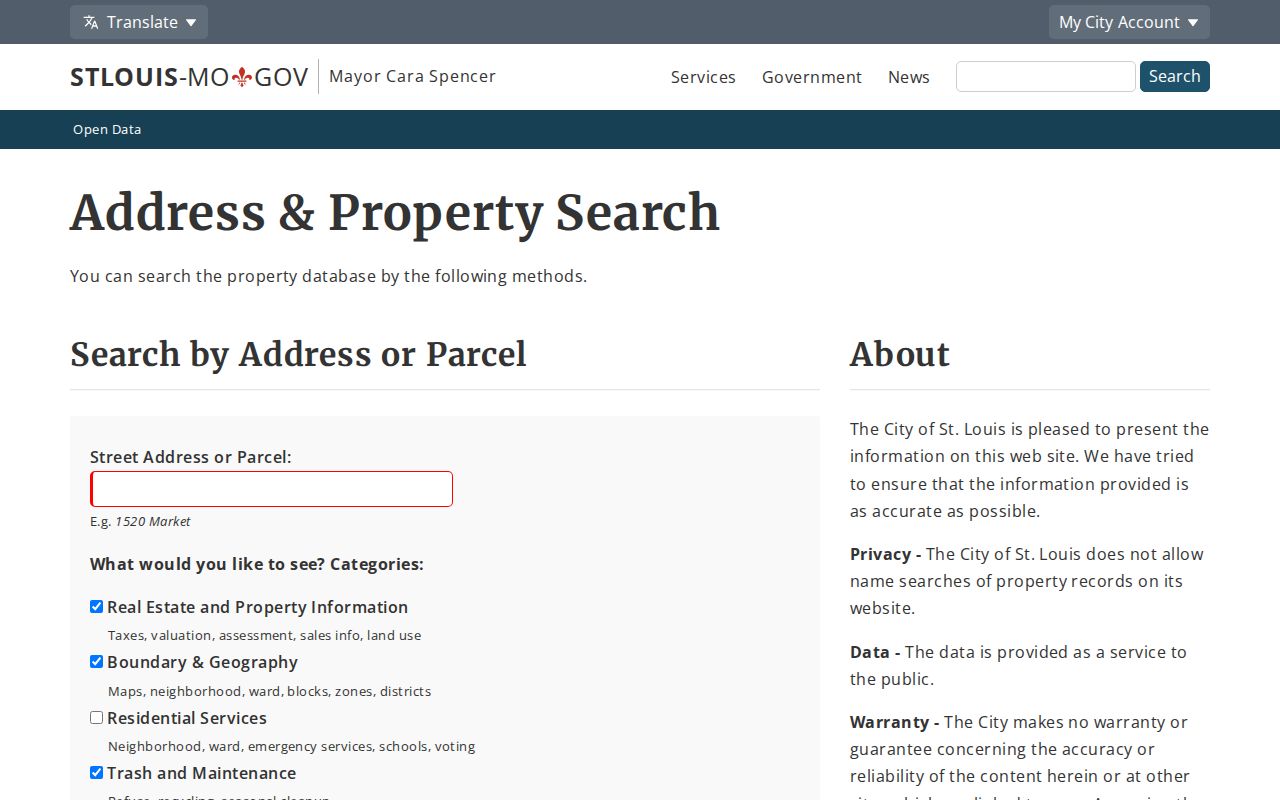
A parcel number is the bridge. It moves you from the city assessor view to related deed records. It also reaches permit records in the street directory. Keep the address, owner, and mailing fields separate in your notes. That keeps the resident lookup clean.
Remember that the city map and the tax inquiry are separate systems. Tax data supports searches by owner, name, address, or property number. Other counties run their own portals, linked from the State Tax Commission directory.
- Parcel
- A mapped unit of land identified in a local tax or property system.
- Situs address
- The location of the land or building, which can differ from the owner's mailing address.
- Roll
- A record list kept for a defined purpose, such as property assessment or voter registration.
Missouri Deeds Name Recorded Parties
A Recorder of Deeds indexes the legal instruments behind every property transfer. That makes the office central to any Missouri resident lookup that reaches past the present owner. Boone County shows how deep local coverage can go. Its online real-estate search covers 1965 to the present. Handwritten index books reach back to 1821. Viewing older document images takes a subscription, and tax-lien images are not online at all. Those dates hold for Boone County only. Every other Missouri county sets its own portal cutoffs and copy rules.
St. Louis City takes a different route. It offers a free direct land-record search plus paid image and copy options. A portal may stop short of the year you need. Ask the Recorder about in-office terminals or index books. Then try Archives microfilm. Grantor and grantee names are the core of the index. A grantor transfers an interest; a grantee receives one. Those names tie a parcel to past owners, though not necessarily to occupants. Start with the parcel and legal description, then follow the indexed transfer. A name alone can drag in unrelated properties.
For a mail or in-person search in St. Louis City, the fee is $20 per ten-year grantor or grantee search. In person, uncertified copies run $3 for the first page and $2 per added page. Tapestry adds its own online fees. Ask the office about certification and older indexes.
Missouri Case.net Needs a Case Context
Case.net opens public Missouri court records to anyone with a case in mind. It searches by litigant name, case number, filing date, and scheduled hearing. A name search returns people named as litigants, not every witness mentioned in the file. Add the county, a date range, and the case type to narrow a common name. A known case number is sharper still.
A typical result shows the case style and number. Party names, filing date, status, docket events, and a disposition appear too. A linked docket entry can open a public document. A missing link proves nothing about whether the file is empty. Juvenile, sealed, expunged, and protected-order material stays hidden. Public users can also pull public case documents at courthouse terminals. Local clerks set their own copy and certification procedures.
For St. Louis City traffic and violations, use Case.net with the 22nd Judicial Circuit selected. Pick the location and the case type as well. Many pre-2024 cases were imported into the system. Older or missing citations may need the court itself. A municipal search is not a criminal-history report.
Missouri Death Index Opens Older Records
The State Archives death-certificate database is a historical name search, not a living-resident index. It holds records eligible for transfer after 50 years. It advertises coverage from 1910 to 1975, with additions over time. Search by name, year range, and county. Spouse and parent fields exist for only part of the collection. The project reports more than 2.5 million records.
The free search may link a certificate image. But a gap does not mean no certificate exists. These images are not certified copies; eligible certified copies come from DHSS. Compare county, year, spouse, or parent details to confirm a match. Search Missouri's historical death-certificate index, then check the FAQ for transfer and image limits.
Missouri Vital Records Have Different Rules
Missouri keeps its vital records under one roof at the state level. DHSS holds birth, death, and fetal-death records dating to 1910. Marriage and divorce statements go back to July 1, 1948. Access is limited, though. Requesters must show identity documents. They must also show a direct and tangible interest under RSMo 193.255 and 19 CSR 10-10 before recent certified copies are released.
The fees are fixed by record type. A birth or fetal/stillbirth copy runs $15. A death copy costs $14 for the first and $11 for each additional one. Mail orders need notarization, ID, eligibility paperwork, and a stamped return envelope. Expect four to eight weeks for processing. Check the current application instructions before ordering anything.
Some records live elsewhere in Missouri. Local Recorders keep the original certified marriage certificates. Circuit clerks hold the divorce decrees. A DHSS statement for an event since July 1, 1948 is a different document entirely. Birth-parent searches run through separate adoptee-rights, registry, or confidential-intermediary routes. Each route has its own eligibility and consent rules.
Walk-in service exists at 115 local public-health agencies. None of them hold state-level birth and death certificates. The Jefferson City office recommends appointments between 9 a.m. and 3 p.m. Same-day service is never guaranteed, though. DHSS is phasing in MoEVR 2.0 across 2026–2027. Confirm current instructions before making the trip.
Missouri Archives Bridge County Gaps
Older county books often stop before the years a researcher needs. The State Archives fills that gap. Its County and Municipal Records database lets you browse by county, office, record type, keyword or city. You can also narrow by year range. It is a browse tool, though, not a statewide name index. Microfilm reaches all 114 counties, but series and dates vary widely. Some entries still have no online image.
Insider tip: pick the county and record series first. Set the years after that. A name search that comes up empty may just be fighting the browse structure. The record itself may not be missing at all. The Archives' 2025 newsletter counted over 10,000 volumes from 103 counties plus 55,000 judicial additions. Yet plenty of books remain unindexed or offline.
Start with the County Records browse page in the Archives card. Then confirm what you find against an image. A book and page citation also works. So does the original office record itself.
Offline options still work well. Try the reading room, microfilm, interlibrary loan, or a local custodian. Reels are cataloged by series and dates, not by every name. So save the county, office, reel or volume number, and page as you go.
Historical Missouri Resident Directories
Missouri directories, maps, plats, and newspapers can carry a search across the years between censuses or address indexes. St. Louis Public Library holds Haines Criss-Cross directories, house-numbering certificates, maps, yearbooks, and microfilm. UMSL digitized Gould's directories and Blue Books spanning 1872 to 1900. Holdings differ from town to town.
Treat any directory as a dated snapshot. An entry may name only the household head, an address, a business, or a telephone subscriber, and the edition can lag well behind the information it gathered. A missing person can simply mean the book's scope was narrow, a number changed, or a household was omitted. The Missouri city directory collections page walks through the libraries, the year spans, and how to read an entry.
Sanborn maps cover 376 Missouri towns and cities from 1867 to 1970. They show buildings, not people. Pair them with a dated directory, plat, obituary, or deed to place residents in context.
Missouri Records Do Not Prove Current Residence
A public record documents an event or a relationship, never a whole household. A deed can name a remote owner. A permit may list an agent. Voter files hold only their statutory fields, and a directory preserves an address from long ago. Always compare sources by type and by date.
| Source type | Useful for | What it cannot settle alone |
|---|---|---|
| Official office record | A dated entry with a named custodian and stated access rules | Whether every person at an address lived there |
| Commercial data compilation | A lead to a possible public or purchased source | Whether an entry is current, matched, or complete |
Commercial compilations go stale or mismatch people. Verify every lead against original records before trusting it. Broker opt-outs never touch government files or archive copies.
Keep deed owners, voters, permit applicants, licensees, and past directory entries separate. They may describe different people at different dates. Record the source, date, jurisdiction, and the field that matched, and copy only what your question requires.
The Treasurer's unclaimed-property tool exists to reunite owners and heirs with funds, not to locate occupants. A last-known address may be years old. Use the free state claim search and the official claim process it describes.
Missouri Postal Cities Cross Legal Lines
Postal city, ZIP code, municipality, tax jurisdiction, and school boundary each follow their own map. Searches around St. Louis and Kansas City feel this most. St. Louis City sits independent of its county. Kansas City records may live in Jackson, Clay, Platte, or Cass systems.
Census ZCTAs are statistical shapes rather than exact delivery routes. PO Box-only ZIPs may cover almost no residences. Confirm delivery through USPS, then use a parcel map to pin down the legal jurisdiction. Keep both the source wording and a normalized place name. The Missouri ZIP Directory lays out the lookup tools and their limits.
Missouri Safe at Home Protects New Addresses
Missouri Safe at Home participants may list a substitute address on new voter, court, law-enforcement, school, city, county, library, and vehicle records. The program serves eligible survivors and their household members. It does not erase older records or expose where anyone actually lives.
The Secretary of State runs the program under RSMo 589.660–589.683 and 15 CSR 30-70; the Safe at Home page details who qualifies. Missouri voter law separately lets certain protected voters ask that their address stay closed. Preserve substitute addresses exactly as shown, since older records may predate participation.
Missouri Search Results Need a Date
Write down the portal, office, search date, county, record number, and the field that matched. Assessments, deeds, dockets, and directories each reflect different moments in time. For common names, compare independent fields and leave uncertain identity links unresolved rather than forced.
Several Missouri tools are in flux or uneven in coverage. DHSS is phasing in MoEVR 2.0 during 2026–2027. The Archives keeps adding county and judicial material. Every recorder and assessor sets its own online cutoff. Missouri has no verified statewide property-fraud alert subscription. Before paying for a copy or leaning on a result, check the named custodian's live instructions.
For fees, coverage, or eligibility questions, open the official page. You can also ask the custodian whether the index and request form are current. A dated search note also helps explain differences that surface later.