
Missouri Resident Lookup Coverage
Every Missouri resident lookup leans on a record with a named custodian. An assessor entry ties an owner to a parcel. A voter match confirms a registration. A court result names a litigant, yet none of those roles proves where a person lives today.
| Record | What It Confirms | Where | Access |
|---|---|---|---|
| Assessor or tax roll | Owner, parcel, situs and mailing address | County assessor or collector; St. Louis City address portal | Often free online; some portals do not allow name search |
| Recorded deed | Named grantor and grantee, transfer date and legal description | County Recorder of Deeds or St. Louis City Recorder | Online indexes vary; counter, mail and older books may be needed |
| Voter record | Own registration match and polling information; limited fields by request | Missouri SOS lookup and local election authority | Exact-match self-check; public file access follows statute |
| Case.net docket | Party name, case type, filing date, events and public disposition | Missouri Courts | Online case information; clerk or courthouse terminal for copies and some files |
| Vital record | Historical death entry or eligible certified record | State Archives, DHSS, local recorder or circuit clerk | Old death index is public; recent certificates have eligibility rules |
| Business or license filing | Entity role, agent, profession or license status | Missouri SOS or Professional Registration | Public online search; an office address is not a residence record |
| Historical directory | Past name, address, telephone or occupation in a dated source | Libraries, State Archives and historical collections | Online, microfilm or in-person access depends on the title |
Missouri counts 114 counties plus the independent City of St. Louis. Switching the county or city changes which assessor, Recorder of Deeds, election authority and clerk hold the record. Keep the jurisdiction attached to every result.
Verify One Missouri Resident in Case.net
Case.net name searches return people entered as litigants, not every name in a file. Pick a court or county first. A supported date or case number separates similar people. St. Louis City municipal directions tell searchers to choose the 22nd Judicial Circuit and set the location or case type when needed.
- With an address, find the parcel and legal description in assessor or GIS records. Keep the owner’s mailing address separate from the parcel address.
- Search Case.net by party name and court, or use a known case number. Open the case header and final disposition.
- Check a second source that fits the question, such as the death index, an eligible vital record, a business filing or a license entry.
- Order an eligible certified copy from DHSS, the local recorder or the circuit clerk, based on the record type.
| Search field | Type | Required | Use and limits |
|---|---|---|---|
| Litigant name | First and last name | For name search | Searches named parties; spelling or court selection can change results |
| Case number | Complete number | For case-number search | Best when a common name or protected name makes party search weak |
| Filing date | Court and date criteria | For date search | Use a known court or a practical date range |
| Scheduled hearings and trials | Court and date filters | For hearing search | Find a listed proceeding by court and hearing date |
| Date of birth | Date entry | Optional | St. Louis City instructions use MM/DD/YYYY to narrow similar names |
| Case type or location | Dropdown | Optional, useful locally | Municipal, traffic or court-specific options vary by court |
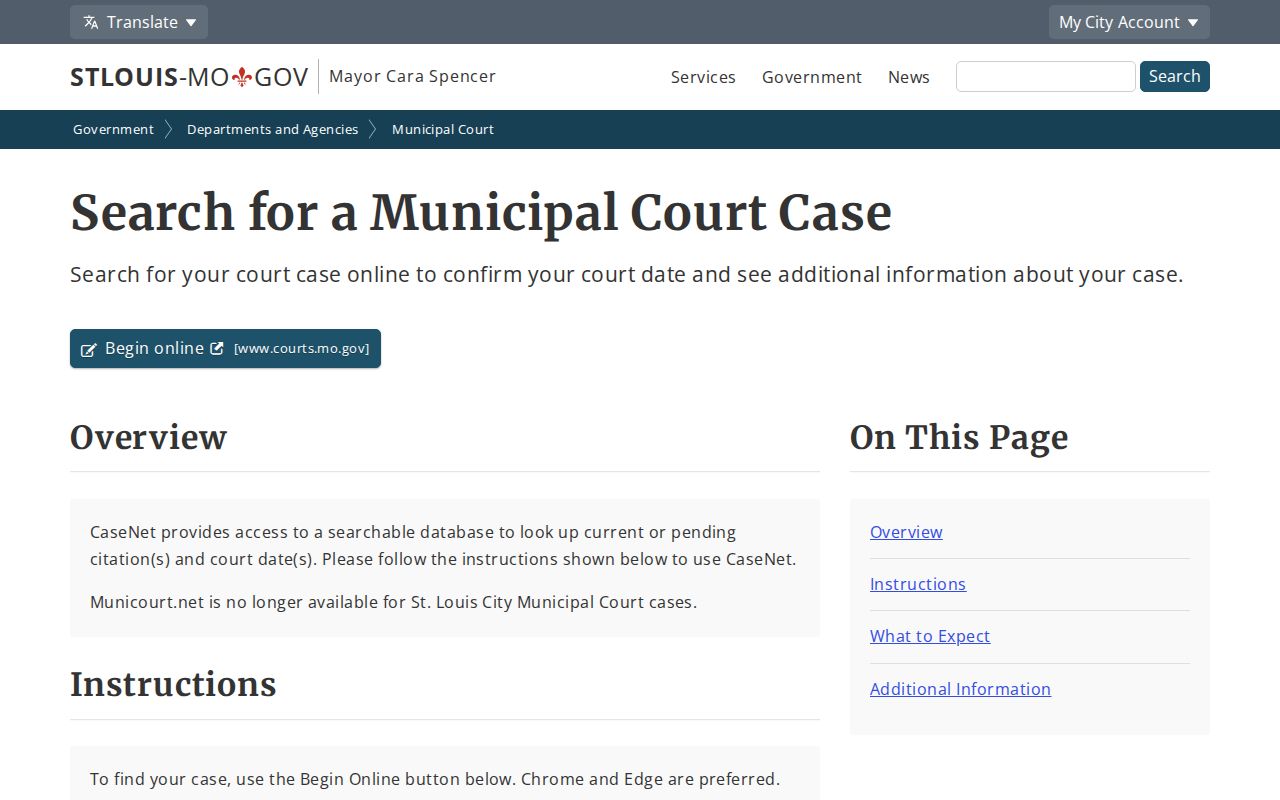
The St. Louis City court search instructions display the local circuit, name, date of birth, location and case-type fields. Use the official court link for current results. The city's own page shows that route step by step.
A result header names the case and its parties. Docket events list the dates and actions the court recorded. Case.net file-viewer help notes that a linked docket entry may open a public document, while protected material can stay unavailable.
- Case number and style, with an E-CASE flag when the file is electronic.
- Named litigant, party type, case type, division, filing date and status.
- Judgment or disposition, docket events, hearing dates and available document links.
- Related-case links that may connect another case to the result.
Case.net shows public case information, not a complete state criminal-history record. A filed case is not a conviction, and a docket event is not a final disposition.
- Docket
- A dated list of actions entered in a case.
- Index and image
- An index names or summarizes a record; an image shows the filed document when access is allowed.
- Certified copy
- A copy sealed or otherwise authenticated by the custodian as an official copy.
Missouri Resident Records and Name Matches
Public does not mean current resident. A deed names transfer parties. A business filing names a role. A voter result concerns registration, a permit names an applicant, and none of those dates overlap. Missouri's records never merge those roles into one verified profile.
When two people share a name, note the spelling, county, middle initial, suffix, date, parcel or case number the source itself shows. Missouri's French, German, African American, immigrant and rural records vary in spelling; accents may drop, middle names may become initials, so never join records just because names look alike.
A "no result" has limits too. Public case search can omit protected parties or sealed files. Voter lookup is an exact self-check, and some assessor systems reject name searches entirely. Save the source and search date, then ask the custodian what the index covers.
Need the whole street, not one person? The Missouri street directory follows address-based records instead.
Missouri Vital Records for a Resident Lookup
DHSS holds births, deaths and fetal deaths from 1910. Marriage and divorce registry statements start July 1, 1948. For deaths over 50 years old, the State Archives keeps a public death index, though that is not an unrestricted certified certificate. RSMo 193.255 sets the direct-and-tangible-interest rule for certified copies.
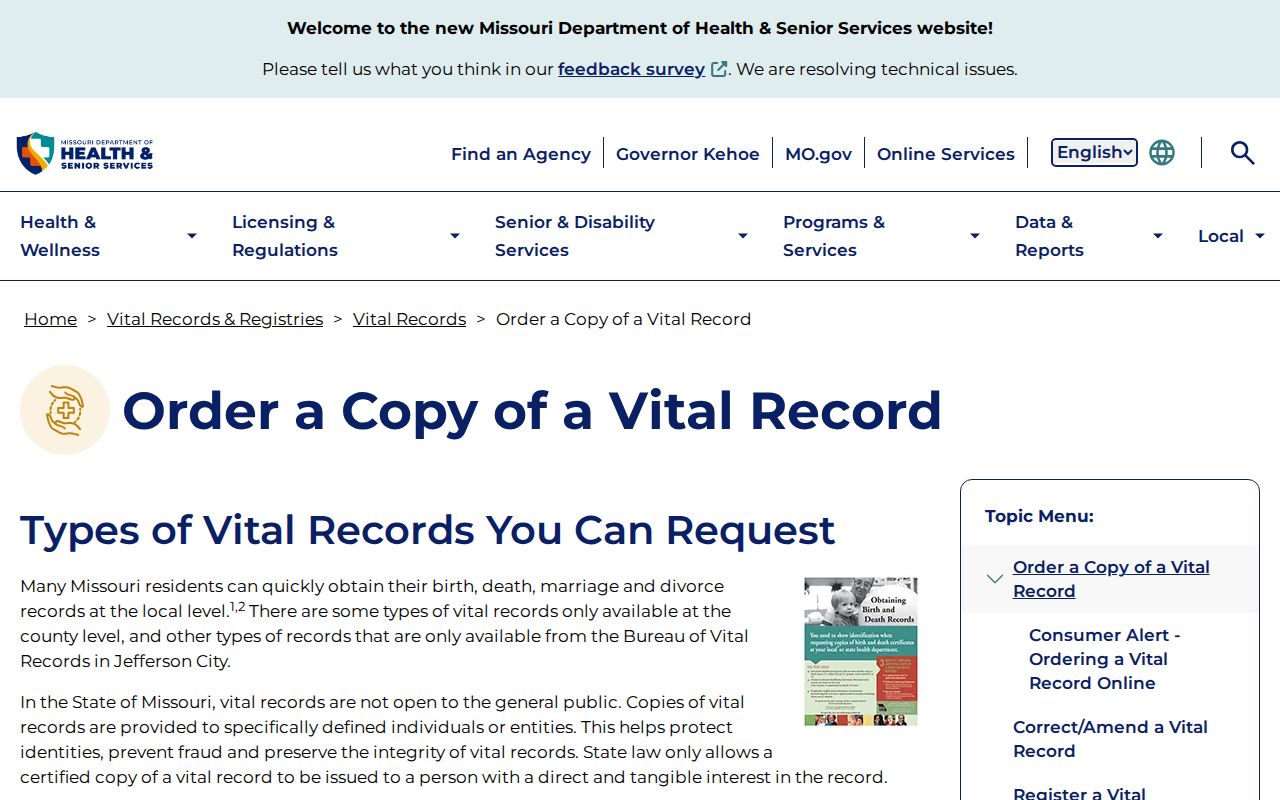
The DHSS ordering instructions cover eligibility, ID, fees, VitalChek, mail and in-person routes, and the Jefferson City lobby works by appointment. MoEVR 2.0 is being phased in during 2026-2027. Check the details before sending any request.
The Missouri birth and death form asks for event details first. Parent or spouse names, applicant contact information, relationship, purpose, fee and a signed declaration complete the application.
- Birth copies cost $15; current records are restricted and require eligibility proof.
- Death copies cost $14 for the first and $11 for each additional. Mail requests need notarization, ID and eligibility papers; processing is estimated at four to eight weeks.
- Local public-health agencies offer eligible walk-in service. The Recorder of Deeds holds the certified local marriage record, and the circuit clerk holds a divorce decree.
Deaths more than 50 years old are the easy starting point. The State Archives death index lists each entry. Many certificates can be viewed as images. Earlier coverage is spottier. A mix of county, church, and local record series survives for parts of 1883 through 1893. Statewide registration did not resume until 1910.
Missouri Voter Lookup for One Resident
The Missouri Voter Information Lookup serves one voter at a time, showing personal registration and polling details. It is not a public name-by-street directory. The form demands every matching field, and spelling must match the registration exactly; the SOS warns a nickname can fail even when the person is registered. Third-party questions go to the local election authority. State law decides which fields it can release.
| Field | Type | Required | Missouri entry note |
|---|---|---|---|
| First name as registered | Text | Yes | Use the registered form, not a nickname |
| Last name | Text | Yes | Enter the spelling on the registration |
| Date of birth | Date | Yes | MM/DD/YYYY |
| Last four SSN digits | Numeric | Yes | Matching field; it is not displayed as a public result |
| County | Dropdown | Yes | Select the county or St. Louis City jurisdiction |
| Street name, if shown | Text | Where displayed | Leave off the road type, such as St, Ln, Rd or Blvd |
Missouri runs 116 local election jurisdictions. Under RSMo 115.157, limited voter fields may be supplied on print or electronic media, subject to the statute, while RSMo 115.158 bars commercial use of the master list. Contact the right local election authority for its request process and fee. Protected addresses offer no path to a physical location.
Missouri Business Records in a Resident Lookup
The Missouri Secretary of State business search reaches registered entities. It also covers fictitious names across the state. Search a distinctive name first. Then open the filings. They show status, charter number, registered agent, principal office, officers, amendments, and any dissolution. That can tie a name to an organization in a resident lookup. Treat the addresses with care, though. A registered agent or principal office is not automatically someone's home. A person listed in an LLC title is not proof of ownership or occupancy. The Division of Professional Registration licensee search adds profession, license number, status, dates, and discipline where a board supplies them. But call any address there a practice address. Save the charter number and retrieval date, since business status shifts over time. A filing links a person to a company. It still cannot replace a deed. It also cannot replace direct confirmation from the records office holding the original.
Note: St. Louis City's address portal does not allow name searches, so a known parcel or street address is the needed starting point there.
Missouri Family and Heir Search Paths
A family question calls for a narrow source, not a broad resident sweep. For an heir, start with the probate index and public wills, letters, inventories, or settlements. An obituary may add a date and a family link. Older loose papers sometimes sit with the county clerk or the State Archives. Chasing a former classmate works differently. Yearbooks, alumni publications, directories, and obituaries can anchor a name to a place and year. Libraries may hold microfilm that goes past any statewide search. The State Historical Society of Missouri genealogy collections hold directories and family-history material. That collection is worth a visit. The Missouri city directory collections also help with an older name or address. Birth-parent questions follow a separate privacy route under the Missouri Adoptee Rights Act, the official registry, or a confidential intermediary. Follow the eligibility, consent, and court rules. Read probate names carefully. A name may belong to an executor, and an obituary may omit relatives entirely.
Missouri Resident Records: Corrections and Privacy
An error belongs to the record maker. A parcel belongs to the assessor or recorder. A vital entry belongs to DHSS or the Archives. A case identity belongs to the court clerk, and the election authority handles voter rolls. CaseNet shows a search result, not the original file. For privacy, Missouri Safe at Home helps eligible survivors. It gives them a substitute address in new public records. It covers qualifying cases such as domestic violence, sexual assault, stalking, or trafficking. It does not erase older records. Keep the substitute address exactly as shown, and never infer a protected location from it. The Sunshine Law sets the clock. Custodians must act as soon as possible and by the end of the third business day unless a reasonable extension applies. The statute requires any written denial to state its legal basis. It also lets the custodian apply confidentiality rules.
Note: Fixing a government record is one request. Removing a data broker's copy is a separate request to a separate custodian.
Legal Limits on a Missouri Resident Lookup
Missouri opens its records for defined public purposes. Limits come from record type, court rule, and confidentiality law. A case filing is not a conviction. An index entry is not a complete document. A public name match is not proof of present residence. When an original record needs review, use the custodian's copy or correction process. Do not rely on assumptions drawn from a match.
Lawful use. Use records for personal, lawful research such as family history, civic review or a genuine effort to reconnect. Do not use information to stalk, harass, intimidate or harm anyone.