
How to Search the Missouri Residents Directory
Missouri has no complete public resident roster. Its 114 counties and independent St. Louis City keep separate property, deed, tax, court, and election records. Start with the jurisdiction tied to an address: parcels identify property, deeds identify transfer parties, and court indexes name litigants. None proves who lives at a house today.
For a current address, identify its parcel and county; for a person, add a date or record number. Older households may require archives. Some vital and court records are restricted, and owner rolls omit occupants. Keep the source, date, and jurisdiction with each Missouri residents directory result.
- Resolve the county or independent St. Louis City for the address.
- Use the assessor or parcel map to identify its number and owner fields.
- Follow transfers through the Recorder, then check a court or agency source if needed.
- For past households, use a dated directory, newspaper, plat, or Archives collection.
- If online access stops, ask the custodian about terminals, indexes, microfilm, or a focused Sunshine Law request.
A focused Sunshine Law request names the custodian, record, dates, and format. The custodian generally must respond by the third business day or explain a delay; a denial should state its legal basis.
Missouri Residents Directory Records and Offices
State offices hold statewide series, but land and tax files remain local. Each county has a Recorder of Deeds, assessor, collector, and election authority; St. Louis City has separate city offices. The Archives county guide routes older requests by office and record type.
The Archives preserves indexes and microfilm; DHSS handles vital records; local custodians keep originals. The Secretary of State selector identifies election authorities.
Sunshine Law copy fees generally allow ten cents per paper page plus permitted staff, research, or duplication time. Advance payment may be required. An unpaid request can be withdrawn after notice and 90 days, or 150 days when estimated fees exceed $1,000. Ask for an estimate first; confidentiality rules still apply.
Missouri State Archives
County records, state indexes, and microfilm
Jefferson City and online collections
DHSS Bureau of Vital Records
930 Wildwood Drive
Jefferson City, MO 65109
573-751-6387
Eligibility and copy procedures vary by record type
Local Election Authorities
County and St. Louis City offices
Registration records are maintained locally
Current Missouri Resident Records
A deed names transfer parties, a voter record shows statutory fields, and a business filing may name a registered agent. These are not interchangeable resident directories; the table shows which custodian can support each fact.
| Record source | What it can show | Keeper | Access path |
|---|---|---|---|
| Assessor or collector record | Parcel owner, tax account, value, and sometimes mailing address | County or city office | Local portal, counter, or request |
| Voter registration | Limited name, year-of-birth, address, and precinct fields | Local election authority | Own-registration lookup; statutory records by request |
| Recorded deed index | Grantor, grantee, filing date, and legal description | Recorder of Deeds | County or city search; older books may be in person or on film |
| Case.net | Public case parties, dates, dockets, and dispositions | Missouri courts | Online case search; clerk or public terminal for records |
| Historical directory | A dated name, address, and printed household notation | Libraries and archives | Digitized collections, shelves, or microfilm |
Use a property result to begin a street search and a dated volume to place an earlier household. Coverage varies by county, so a blank result may be offline or indexed elsewhere.
Missouri Business Records Are Not Home Rolls
The Secretary of State's business-entity search covers registered corporations and business names, including current and dissolved entities. A filing can identify a registered agent, organizer, or business address; those roles do not establish who lives at the listed location. Use the Missouri business search when an entity name or filing needs checking, then follow a property question to the assessor or Recorder of Deeds.
The Division of Professional Registration provides another bounded name source. Its profession-specific pages can show a licensee's name, city or state, license number, status, and issue or expiration dates; board detail and historical depth vary. The Department of Corrections searches people under active supervision, including probationers and parolees, and excludes discharged people and some confidential records. The Highway Patrol's offender registry has its own eligibility and status rules. None is a list of all Missouri residents, and a matching name alone does not connect a license, filing, or registry entry to a home.
Missouri Voter Lookup Has Narrow Fields
The Secretary of State's Missouri Voter Information Lookup checks registration and polling details by exact first and last name, birth date, last four SSN digits, and county. Nicknames or the wrong county can fail. It lets a voter check their own record; it is not a street-address roster.
| Lookup field | Format or use | Limit |
|---|---|---|
| First and last name | Enter the registered spelling | A nickname may fail |
| Date of birth | MM/DD/YYYY | Used to match the registration |
| Last four SSN digits | Four-digit matching field | Not a public display field |
| County | Choose the registration jurisdiction | Missouri keeps local election authorities |
RSMo 115.157 defines public voter fields; RSMo 115.158 limits commercial use. Ask the local election authority about a lawful print or electronic file, specifying jurisdiction, fields, geographic scope, intended use, and format. The office can explain fees and disclosure limits.
A statutory file differs from the self-check form. Public fields include name, year of birth, residential address, ward or precinct, districts, and party designation; birth date and SSN digits are matching fields, not public display fields. Protected-address rules may restrict disclosure.
Missouri Parcel Searches Show Owners
Missouri has no statewide assessor search that joins every county. The State Tax Commission assessor directory helps locate the right county office. St. Louis City offers a useful example: its official address service accepts an address or parcel number, and its page says it does not search by owner name. That city portal is separate from St. Louis County's tax inquiry system.
The St. Louis City example below returns an owner, separate mailing address, parcel and account identifiers, assessed values, tax history, legal description, permits, and map layers. It describes a parcel, not occupants; the owner may be an entity or receive mail elsewhere.
See the St. Louis City address and parcel search for the live lookup.
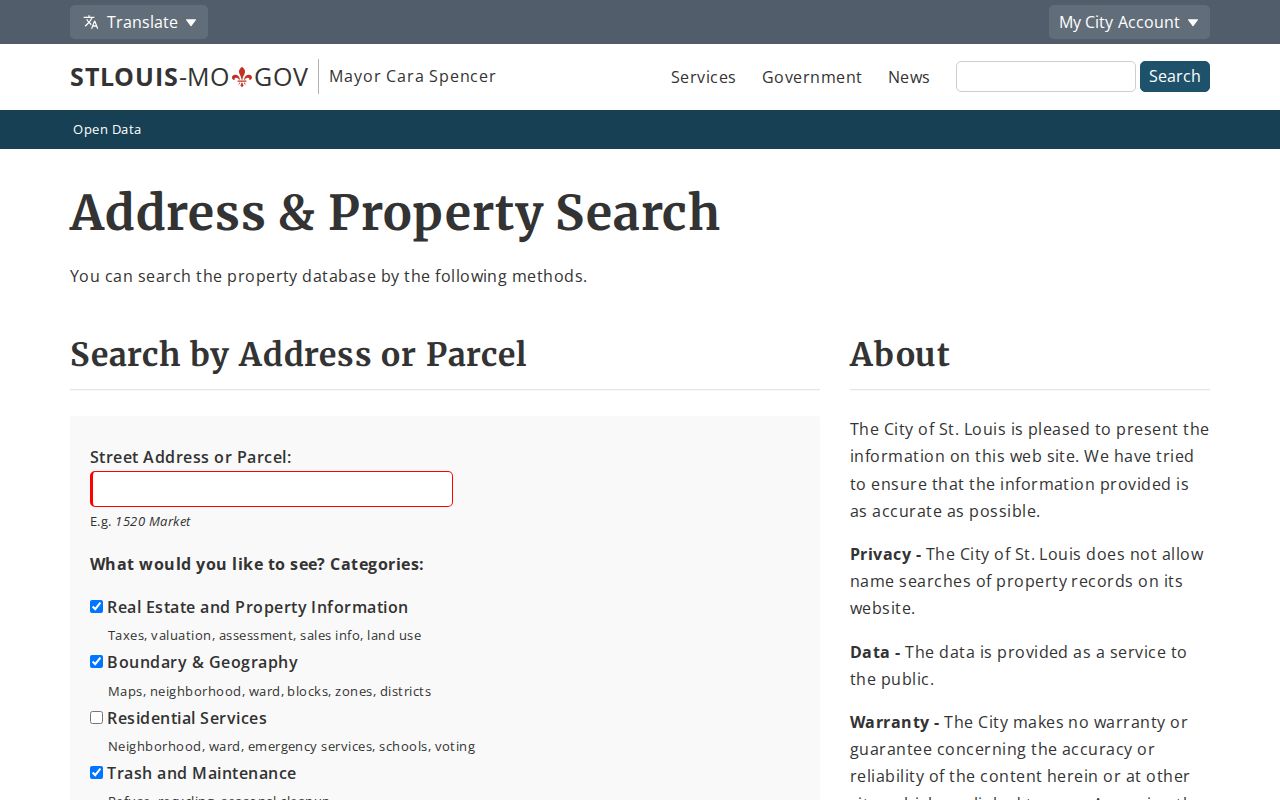
Use the parcel number to move from the city assessor view to related deed or permit records, then keep the address, owner, and mailing fields distinct in your notes.
The city map and tax inquiry are separate systems. Tax data offers owner, name, address, or property-number searches and a data date; other counties use their own portals linked from the State Tax Commission directory.
- Parcel
- A mapped unit of land identified in a local tax or property system.
- Situs address
- The location of the land or building, which can differ from the owner's mailing address.
- Roll
- A record list kept for a defined purpose, such as property assessment or voter registration.
Missouri Deeds Name Recorded Parties
A Recorder of Deeds indexes legal instruments tied to property. Boone County shows how far local coverage can reach: its online real-estate search covers 1965 to the present, while handwritten index books cover 1821 to 1965. Older document images require a subscription, and tax-lien images are not online. These dates apply to Boone County only. Other Missouri counties set their own portal cutoffs and copy procedures.
St. Louis City has a free direct land-record search and paid image or copy paths. When a portal stops before the needed year, ask the Recorder about terminals or index books, then check Archives microfilm. A grantor transfers an interest; a grantee receives it. These names connect a parcel to past owners, not occupants.
St. Louis City accepts mail and in-person searches: $20 per ten-year grantor or grantee search, plus $3 for the first uncertified copy page and $2 per added page in person. Tapestry adds online fees. Ask about certification and older indexes.
A grantor conveys property; a grantee receives it. Start with the parcel and legal description, then follow the indexed transfer. A name alone can point to unrelated properties.
Missouri Case.net Needs a Case Context
Case.net searches public Missouri court information by litigant name, case number, filing date, and scheduled hearing. A name search finds people named as litigants, not every witness or person mentioned in the file. Adding the county or court, a date range, and the case type can narrow a common name. A case number is more precise when one is known.
Results may show the case style and number, party names, filing date, status, docket events, and a disposition. A linked docket entry can open a public document, but a missing link does not prove a file is empty. Juvenile, sealed, expunged, protected-order, and other confidential material may be hidden. Public users can also use courthouse terminals for public case documents. Local clerks set copy and certification procedures.
St. Louis City traffic and violation searches use Case.net settings for the 22nd Judicial Circuit, location, and case type. Many pre-2024 cases were imported; older or missing citations may require the court. A municipal search is not a general criminal-history report.
Missouri Death Index Opens Older Records
The State Archives death-certificate database is a historical name search, not a living-resident index. It covers records eligible for transfer after 50 years and advertises 1910–1975, with additions over time. Search by name, year range, and county; spouse or parent fields are available for only part of the collection.
The free search may link an image, but a gap does not mean no certificate exists. The project reports more than 2.5 million records. Images are not certified copies; eligible certified copies come from DHSS. Compare county, year, spouse, or parent details.
Search Missouri's historical death-certificate index, then check the FAQ for transfer and image limits.
Missouri Vital Records Have Different Rules
Missouri DHSS holds statewide birth, death, and fetal-death records beginning in 1910, along with marriage and divorce statements from July 1, 1948. Recent certified copies are not open to every requester. Eligibility, identity documents, and a direct and tangible interest apply under RSMo 193.255 and 19 CSR 10-10. Local public-health agencies offer walk-in service, but the state repository holds the state-level birth and death certificates.
Birth or fetal/stillbirth copies are listed at $15; death copies cost $14 for the first and $11 for each extra. Mail requests require notarization, ID, eligibility papers, and a stamped return envelope; DHSS estimates four to eight weeks. Older death records can be searched at the Archives, but certified copies come from DHSS. Check the current application instructions before ordering.
Local Recorders hold original certified marriage certificates; circuit clerks hold divorce decrees. DHSS statements for events since July 1, 1948 are different documents. Birth-parent searches use separate adoptee-rights, registry, or confidential-intermediary routes, subject to eligibility and consent rules.
Walk-in service is available through 115 local public-health agencies, which do not hold state-level birth and death certificates. Jefferson City recommends appointments from 9 a.m. to 3 p.m.; same-day service is not guaranteed. DHSS is phasing in MoEVR 2.0 during 2026–2027, so check current instructions before traveling.
Missouri Archives Bridge County Gaps
The State Archives bridges county portals that stop before older books. Its County and Municipal Records database browses by county, office, type, keyword or city, and year range; it is not a statewide name index. Microfilm covers all 114 counties, but series and dates vary. Some records lack online images.
Insider tip: choose county and record series before setting years. A failed name search may reflect the browse structure, not a missing record. The Archives' 2025 newsletter reported over 10,000 volumes from 103 counties and 55,000 judicial additions; that does not mean every book is online or indexed.
Use the County Records browse page in the Archives card, then verify against an image, book and page, or original office record.
If offline, try the reading room, microfilm, interlibrary loan, or local custodian. Reels are described by series and dates, not every name; save the county, office, reel or volume, and page.
Historical Missouri Resident Directories
Missouri directories, maps, plats, and newspapers can bridge gaps between censuses or address indexes. St. Louis Public Library holds Haines Criss-Cross directories, house-numbering certificates, maps, yearbooks, and microfilm. UMSL digitized Gould's directories and Blue Books from 1872 to 1900. Holdings vary by town.
Directories are dated snapshots. They may list a household head, address, business, or telephone subscriber, and the edition can lag the time when the information was collected. A missing person may reflect the book's scope, a changed number, or an omitted household. The Missouri city directory collections page explains the libraries, year spans, and ways to read an entry.
Sanborn maps cover 376 Missouri towns and cities from 1867 to 1970. They show structures, not residents; compare with a dated directory, plat, obituary, or deed.
Missouri Records Do Not Prove Current Residence
A public record describes an event or relationship, not a household. A deed may name a remote owner, a permit an agent, a voter file statutory fields, and a directory an earlier address. Compare sources by type and date.
| Source type | Useful for | What it cannot settle alone |
|---|---|---|
| Official office record | A dated entry with a named custodian and stated access rules | Whether every person at an address lived there |
| Commercial data compilation | A lead to a possible public or purchased source | Whether an entry is current, matched, or complete |
Commercial compilations may be stale or mismatched; verify leads against original records. Broker opt-outs do not change government files or archive copies.
Keep deed owners, voters, permit applicants, licensees, and past directory entries distinct: they may describe different people or dates. Record the source, date, jurisdiction, and matching field, and copy only what the question requires.
The Treasurer's unclaimed-property tool helps owners and heirs find funds, not occupants. A last-known address may be old; use the free state claim search and official claim process.
Missouri Postal Cities Cross Legal Lines
A postal city, ZIP, municipality, tax jurisdiction, and school boundary can refer to different maps. This often affects St. Louis and Kansas City metro searches: St. Louis City is independent of the county, while Kansas City records may sit in Jackson, Clay, Platte, or Cass systems.
Census ZCTAs are statistical shapes, not exact delivery routes; PO Box-only ZIPs may have little residential coverage. Use USPS to confirm delivery, then a parcel map to locate the legal jurisdiction. Preserve both source wording and normalized place names. The Missouri ZIP Directory details lookup tools and limits.
Missouri Safe at Home Protects New Addresses
Missouri Safe at Home participants may use a substitute address on new voter, court, law-enforcement, school, city, county, library, and vehicle records. The program serves eligible survivors and household members; it does not erase older records or reveal the physical location.
The Secretary of State administers the program under RSMo 589.660–589.683 and 15 CSR 30-70; see the Safe at Home page for eligibility. Missouri voter law separately lets certain protected voters seek address closure. Preserve substitutes as shown; older records may predate participation.
Missouri Search Results Need a Date
Note the portal, office, search date, county, record number, and matching field. Assessments, deeds, dockets, and directories reflect different dates. Compare independent fields for common names, and leave uncertain identity links unresolved.
Several Missouri tools are changing or have uneven coverage. DHSS is phasing in MoEVR 2.0 during 2026–2027. The Archives continues to add county and judicial material. Each recorder and assessor sets its own online cutoff, and Missouri has no verified statewide property-fraud alert subscription. Check the named custodian's live instructions before paying for a copy or relying on a result.
For fees, coverage, or eligibility, check the official page or ask the custodian whether its index and request form are current. A dated search note helps explain later differences.