
Missouri City Directory Collections by Era
Missouri has no single directory series for every town and year. St. Louis has the strongest digitized run; other verified examples sit in library stacks, microfilm, and local collections. The table separates dated holdings from titles with no exact run in the catalog. One city’s collection does not establish coverage for a neighboring county or suburb.
| Collection | Years or edition | Where held | Access route |
|---|---|---|---|
| Gould's St. Louis directories and Blue Books | 1872-1900 | UMSL Mercantile Library digital collection | Free search and browse online |
| Earlier St. Louis directory material | 1821-1870, much of the run | Washington University Digital Gateway | Digital collection; check title coverage |
| St. Louis printed directories | 1859 citation; later old volumes, exact run unstated | SHSMO, UMSL, and SLPL Genealogy | Catalog search, microfilm, or in-library scan |
| Haines Criss-Cross directories | Exact run not stated | St. Louis Room, Central Library | In-room lookup; photocopy or scan by request |
| Hoye's and Gate City Kansas City directories | 1897-1907; 1910-1912 | SHSMO catalogs and library copies | Verify edition; some copies are licensed |
| Jefferson City directories | 1921; 1931 | SHSMO and local libraries | Use the cited edition and cross-check office addresses |
| Southwest City directory | December 1973 | SHSMO Rolla, collection R0788 | One folder; appointment required |
| St. Louis telephone books | 1949-1980; selected suburban years 1953, 1956, 1966 | SLPL Rare Books and Manuscripts, SC 20:16 | Finding aid and controlled reference request |
Several catalog descriptions identify a title and holding without listing every year on the shelf. The St. Louis Room page does not give a complete Haines run, and the Columbia reverse-directory handout does not state its years. No source establishes a uniform statewide start or end date, so gaps should be checked title by title rather than filled by assumption.
Missouri's UMSL Directory Scans
The St. Louis Mercantile Library at the University of Missouri–St. Louis digitizes directories, Blue Books, gazetteers, rosters, and guides. Gould’s St. Louis directories and Blue Books are strongest for 1872-1900, linking names to addresses, businesses, and civic groups. Washington University’s Digital Gateway fills much of 1821-1870. Both collections still have gaps by title and year.
The UMSL Mercantile Library digital directory collection provides the online catalog and scans. A collection page is a starting point, not proof that a specific year or neighborhood is represented. Search the catalog by year and title, then inspect the volume’s own title page before using the entry as a date-specific clue.
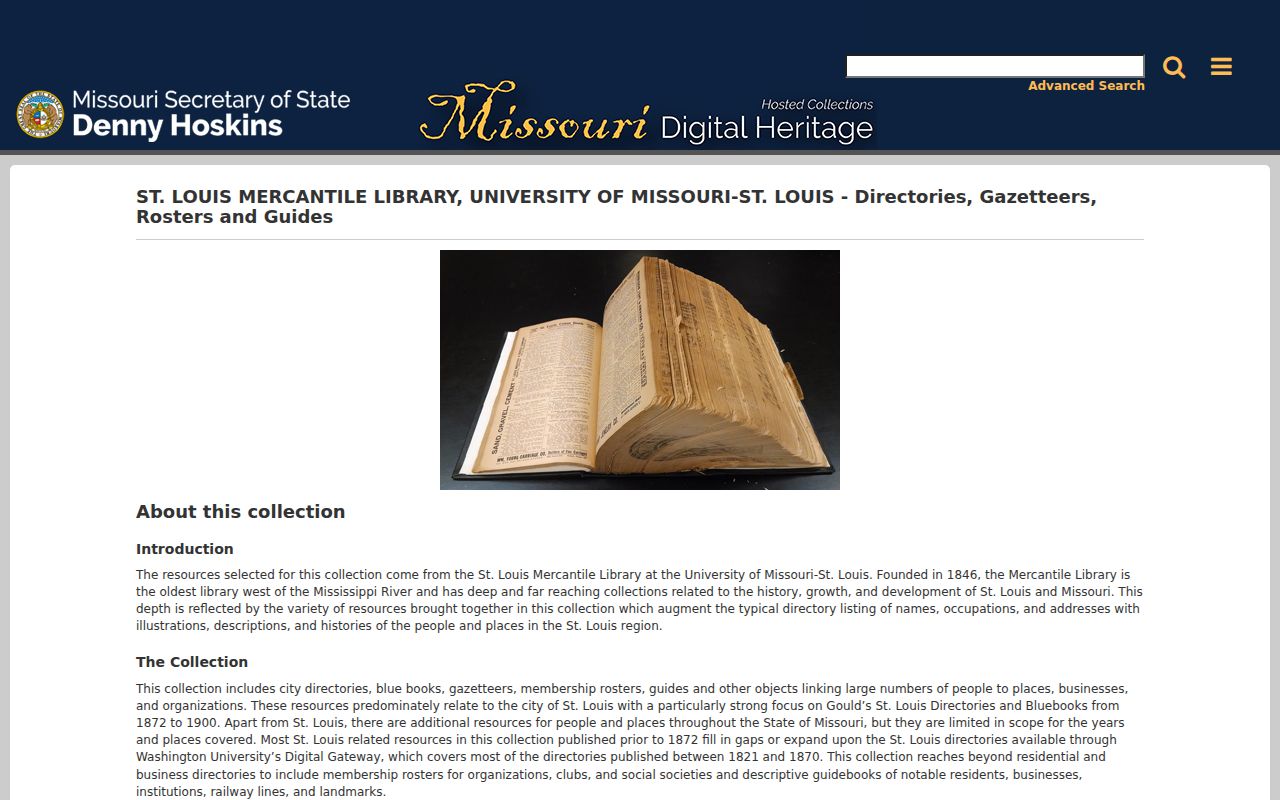
The pictured collection page identifies a group of reference volumes; the page does not show a complete run on one screen. Confirm the scan’s title, place, and edition before comparing entries across years.
Missouri's St. Louis Directory Shelves
St. Louis Public Library divides its local-history resources among the Genealogy Department, St. Louis Room, and Rare Books and Manuscripts on Central Library’s Special Collections floor. Genealogy holds microfilmed city directories and old newspapers, with readers and scanners. The St. Louis Room lists Haines Criss-Cross directories, maps, house-numbering certificates from the City Building Department, high-school yearbooks, local-government publications, and clipping and vertical files. This is a useful route when an online scan stops short of a street or household question.
The SLPL Genealogy resources page describes its online and in-library research tools. The St. Louis Room guide lists Monday-Saturday, 10 a.m.-6 p.m., and (314) 539-0371; confirm current hours before travel. Ancestry Library Edition is in-library access, and FamilySearch affiliate records, HeritageQuest, historic newspapers, obituary indexes, and Digital Sanborn Maps have their own access conditions. Some material can be searched from home, while licensed databases and physical volumes require a library visit or a reference request.
The St. Louis Room description lists house-numbering certificates, reverse directories, maps, and yearbooks.
The St. Louis Public Library genealogy page is pictured below and points to its research tools.
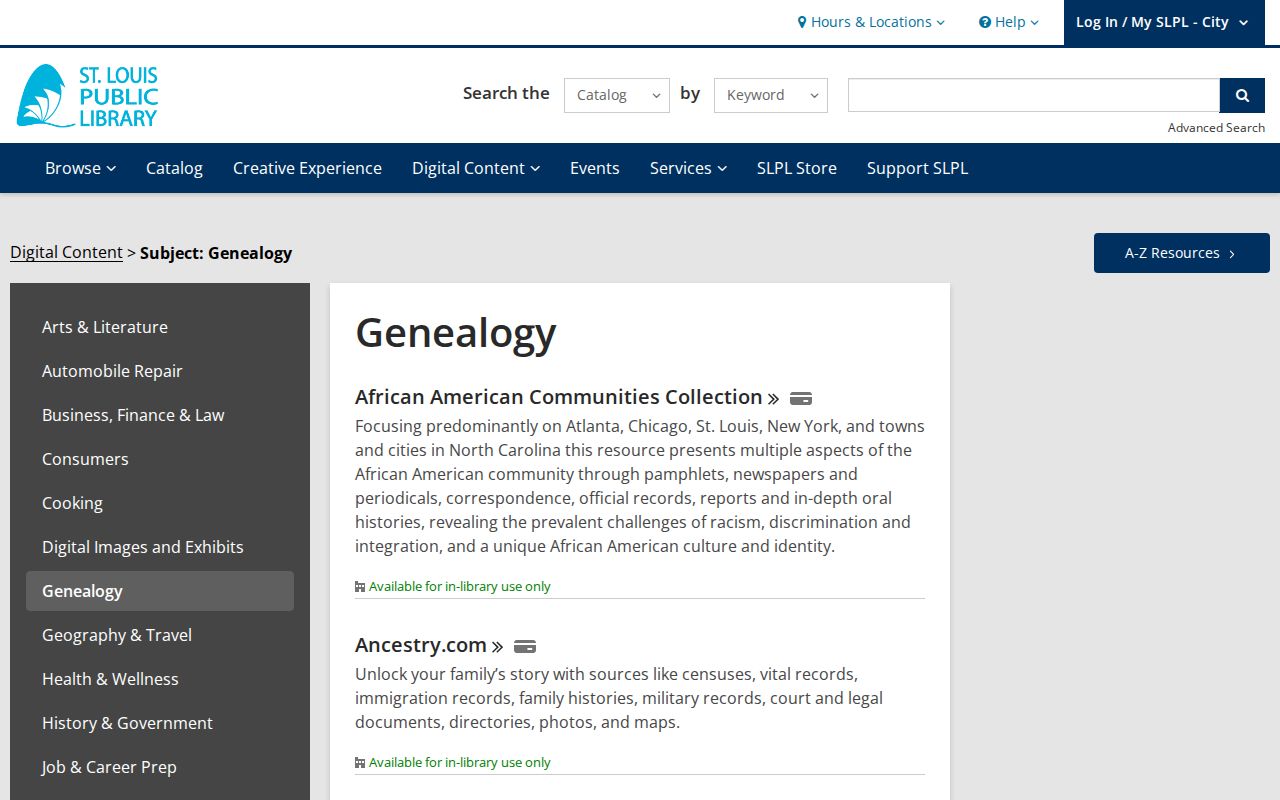
The library’s genealogy page combines several databases and print collections, but none is described as a complete current resident list. Use each source for its stated time span and verify important details against another record.
SHSMO's Missouri Directory Trail
The State Historical Society of Missouri is a statewide fallback when a local library has no copy or a town directory appears in a catalog rather than online. Its genealogy reference collection includes cemetery transcriptions, city directories, county and town histories, family histories, church histories, newspapers, periodicals, and surname resources. SHSMO has research centers in Columbia, Kansas City, Rolla, St. Louis, Cape Girardeau, and Springfield. The Southwest City Lions Club’s December 1973 directory, for example, is held as one folder at Rolla and requires an appointment.
SHSMO’s genealogy guide helps identify the relevant collection type; the research-services page explains on-site use, staff help, and interlibrary loan. Collections are non-circulating. Selected microfilm can travel through ILL, generally one or two reels for a two-week use period; the listed domestic service rate is $15. Check the catalog and ask staff to confirm the exact title, place, and year before requesting a reel.
The State Historical Society’s online research guide is the source represented below.
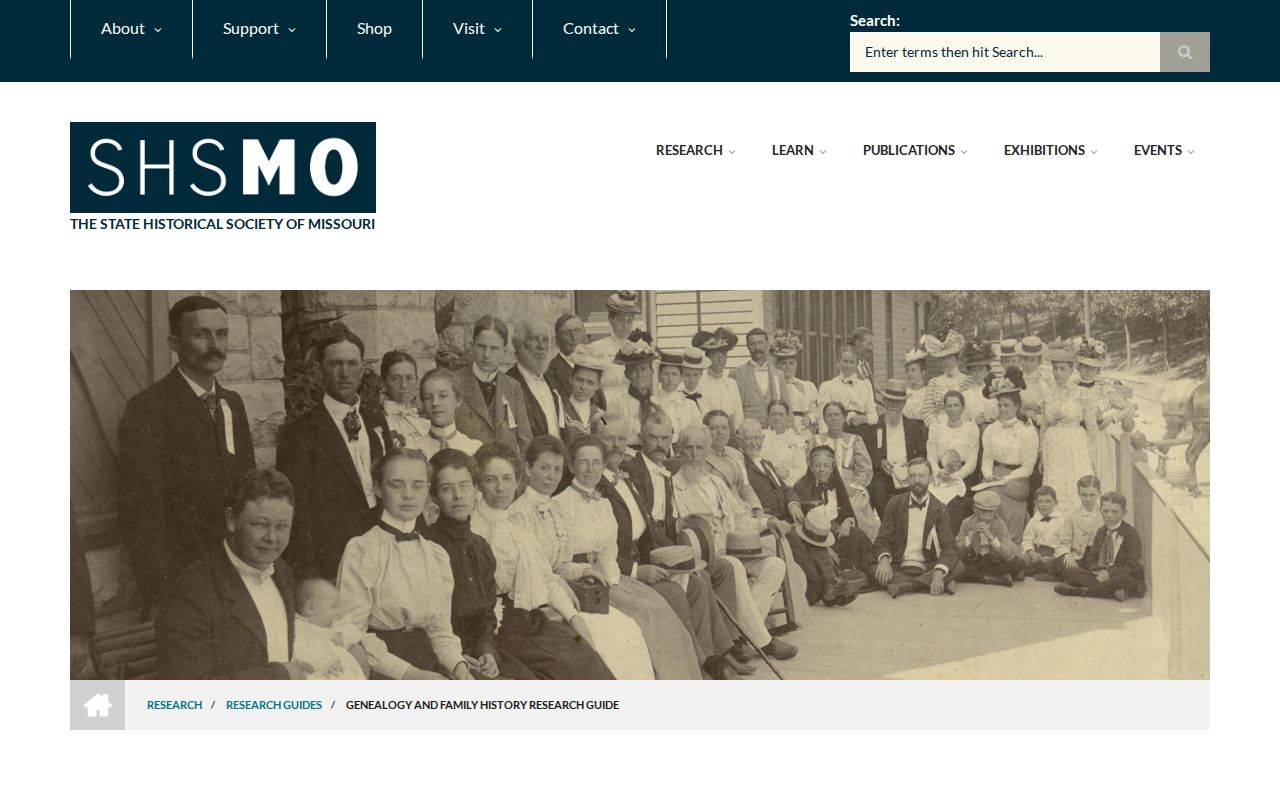
The image shows the research guide rather than a directory page. Use its catalog and service instructions to locate a volume, then treat the actual entry and the guide as separate sources.
Reading Missouri City Directory Entries
Directory entries are not identical from one publisher to the next. A city directory may list a principal resident alphabetically, place the address under a street heading, give a telephone subscriber, or identify a business and its office. The printed wording and the edition’s abbreviation key control what each mark means. Do not assume that a spouse, boarder, renter, or every person in a household appears.
| Entry field | What to record |
|---|---|
| Name | Copy surname, initials, spelling, and any printed household note. |
| Address | Preserve the number and street exactly as printed; note a separate office address. |
| Occupation or affiliation | Record the historical descriptor only as the edition gives it. |
| Spouse or status | Transcribe a spouse, widow notation, or other mark without expanding an abbreviation by guess. |
| Residence or ownership mark | Record any owner/renter or residence code, then check that volume’s key because meanings vary. |
| Telephone or business | Later books may add a number, business heading, or advertisement. |
| Street section | When present, capture the street-order entry and its cross-reference to the name list. |
- Criss-cross directory
- A reverse book arranged by street address, useful when the house number is known but the resident’s name is not.
- Householder index
- An alphabetical name section used to find an entry; its coverage and household labels depend on the publisher.
- Abbreviation key
- The edition’s guide to short marks and codes. Check it before reading a status or household notation.
A worked SHSMO citation places Henry P. Andrae at 105 West High Street in the 1921 Jefferson City directory and Augusta J. “Gussie” Andrae at that address in 1931. It cites an occupation and an Official Manual cross-check, but no full scan or complete key was exposed. Treat the citation as a lead, not a source for details it does not show.
Reverse Directories and Missouri Telephone Years
Missouri directory formats changed over time. Early books often emphasize residents and businesses; criss-cross volumes sort by street address, while phone books list subscribers, not every household. SLPL’s St. Louis telephone books span 1949-1980, with selected suburban volumes for 1953, 1956, and 1966. The Columbia Missourian Library identifies a Polk reverse directory, but gives no year run.
Use an alphabetical list when you know a name and a reverse section when you know an address. Keep a business or office address separate from a home listing unless the source labels both.
St. Louis Room staff can make scans or copies. Telephone books use a controlled reference process, and a later issue may be missing even when earlier and later volumes survive.
Connect Missouri Addresses to Historic Maps
Insider tip: Pair an old street address with a map or house-numbering record before treating it as the same parcel. St. Louis Room certificates and Sanborn maps help place buildings in their period. SHSMO’s Missouri plats span roughly 1875-1921 and can show subdivisions, lots, blocks, and landowners.
SHSMO’s Missouri plat-map collection can help translate a legal description or older place name into a map location. Sanborn fire-insurance maps, available through SLPL’s resources and other licensed interfaces, show building footprints, materials, and street layouts from 1867-1970. They date the built environment, not the residents. Compare map labels to the directory’s source spelling and retain both rather than replacing one with the other.
Trace a Missouri Household Between Censuses
Directories add dated points between federal census schedules, but their edition year and household coverage need care. Missouri family research can use this sequence to test a name and address without treating a single listing as a full household record:
- Start with the closest known place and year. Search the alphabetical section for the exact name, then try initials or a known spelling variant.
- Copy the address, date, household notation, and any occupation or business clue exactly as printed. Keep the title page and abbreviation key with the notes.
- Repeat in nearby annual or five-year volumes. Track each address change, and use a reverse section to see whether a known address returns a different name.
- Pair directory entries with available federal census years. Missouri census research can use 1850-1880 and 1900-1950 schedules; the 1890 population census was destroyed.
- Check an address shift against a plat, house-numbering certificate, deed, or permit. Use an obituary, cemetery index, church record, or probate file as a separate family-history lead.
A directory may have gone to press before its cover date, and a person can be absent because the title was selective or the address outside its territory. The 1890 gap makes directories useful, but not a census replacement. For one address’s owner and occupant history, use the Missouri previous-residents trail with the volume.
Missouri Directory Search Gaps
Myth check: a blank result does not establish absence. Women, boarders, children, rural households, people without telephones, Black residents in undercovered neighborhoods, and businesses listed under an owner’s name may be missing or shown differently. Ask which title covered that place and year.
Check the scan, not only the index. Try initials, a spouse’s name, a street section, and a nearby edition. Keep the original spelling and place wording, then compare the lead with a deed, newspaper, vital record, court file, or Archives series.
The Missouri State Archives county-records guide lists microfilm for all 114 counties, though series and year depth differ. Its county-records interface is a browse by county, office, record type, keyword, city, and year, not a statewide resident-name index. If a digital run ends, ask the holding library about microfilm, an in-person terminal, a reference scan, or an interlibrary-loan reel before assuming the record is lost.